
Find the best anti aging skincare for 50s in 2026. Explore ingredients, routines, and treatments for mature skin. Discover your ideal regimen today.
Best Anti Aging Skincare for 50s: 2026 Guide
Sep 13, 2026

Table of Contents
- What Changes in Your Skin During Your 50s
- Best Ingredients for Mature Skin: What Actually Works
- Retinol for Beginners Over 50: How to Start Without Irritation
- Building a Skincare Routine for Women Over 50
- Budget vs. Luxury: Does Price Predict Results?
- How Hormonal Shifts in Your 50s Affect Your Skin
- Choosing the Best Anti Aging Skincare for 50s: A Decision Framework
- Frequently Asked Questions
Last Updated: September 13, 2026
What Changes in Your Skin During Your 50s
The best anti aging skincare for 50s starts with understanding what actually shifts beneath the surface. During your 50s, estrogen decline accelerates collagen breakdown, and skin produces less oil, thins out, and loses the lipid barrier that once kept moisture locked in (pubmed.ncbi.nlm.nih.gov). Cell turnover slows noticeably, so dullness, fine lines, and hyperpigmentation linger longer than they used to.
Below, we break down the ingredients, routines, and trade-offs that actually move the needle, plus the two angles most guides skip entirely: how hormones change the equation, and where budget formulas genuinely match luxury ones.
Best Ingredients for Mature Skin: What Actually Works
The best ingredients for mature skin fall into two categories: those that rebuild structure and those that defend it. Retinoids and peptides handle the first job. Antioxidants, sunscreen, and barrier-supporting moisturizers handle the second. Everything else is supporting cast.
Retinoids and Peptides for Cell Turnover and Collagen
Retinoids are vitamin A derivatives that speed up cell turnover and stimulate collagen production, making them the most studied anti-aging ingredient class available (pubmed.ncbi.nlm.nih.gov). Peptides are short chains of amino acids that signal skin to produce more collagen and elastin, supporting firmness and elasticity over time.
A common mistake is treating these as interchangeable. They are not. Retinoids do the heavy lifting on texture and fine lines; peptides work more gradually on skin density and firming. Together, they address wrinkles from two directions.
Antioxidants, SPF, and Barrier Support
Antioxidants such as vitamin C neutralize free radicals from UV exposure and pollution that accelerate cellular repair failure. SPF prevents new damage and is non-negotiable for anyone targeting age spots or hyperpigmentation, since unprotected sun exposure undoes months of topical treatment (pubmed.ncbi.nlm.nih.gov).
Hyaluronic acid and ceramide-rich moisturizers rebuild the lipid barrier, which thins with age. Without that barrier, even clinical-strength actives struggle to penetrate, and hydration evaporates before it can help.
Retinol for Beginners Over 50: How to Start Without Irritation
Retinol for beginners over 50 should start at the lowest effective concentration, applied two nights per week, buffered with moisturizer. Mature skin tolerates retinol differently than younger skin because the barrier is thinner and slower to recover.
Here is a starter protocol that minimizes irritation:
- Week 1-2: Apply a pea-sized amount twice weekly, after moisturizer
- Week 3-4: Increase to three nights if no redness or flaking
- Week 5-6: Move application before moisturizer for better absorption
- Week 7+: Add a fourth night only if skin feels calm
- Always pair with daily SPF and a fragrance-free night cream
Watch Out
Skipping the buffering step is the most common cause of retinol irritation in mature skin. Applying retinol directly to bare skin in week one often triggers redness and peeling that makes people quit before results appear, typically around week eight to twelve.
Building a Skincare Routine for Women Over 50
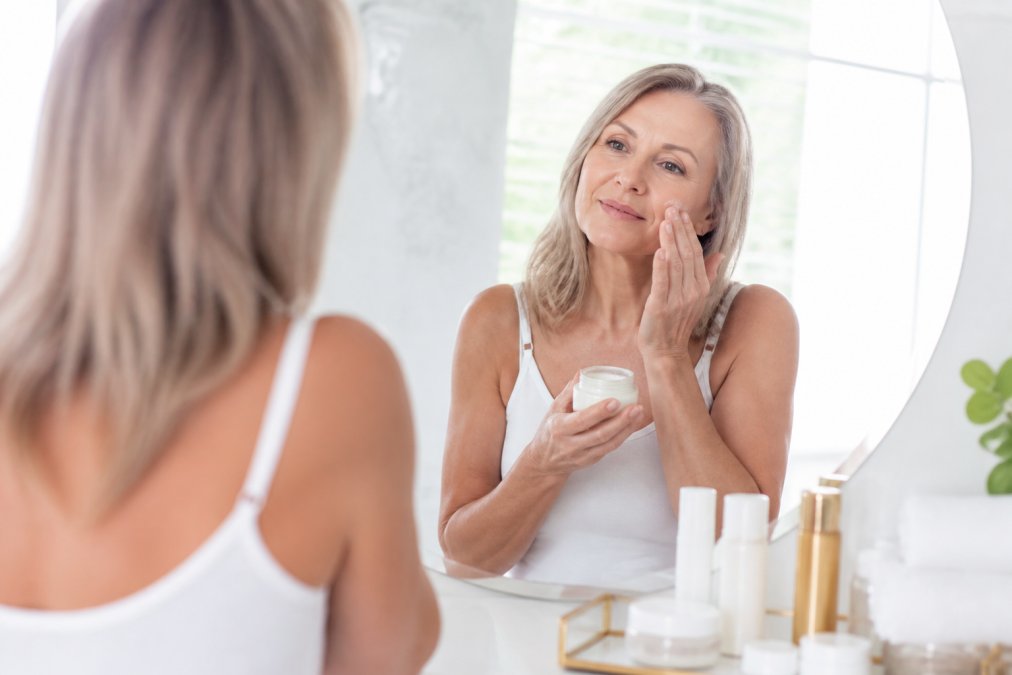
A skincare routine for women over 50 should be short enough to follow daily and structured enough to deliver results. The most effective routines prioritize consistency over complexity, but the order and timing of steps matters more at this stage than it did in your 40s, because a thinner barrier absorbs actives faster and recovers from irritation more slowly.
Morning and Evening Steps That Fit Real Life
Morning steps focus on protection; evening steps focus on repair. Keep both under five minutes.
| Time | Step | Purpose |
|---|---|---|
| Morning | Gentle cleanser | Remove overnight buildup without stripping |
| Morning | Antioxidant serum | Defend against UV and pollution |
| Morning | Moisturizer | Support the lipid barrier |
| Morning | SPF 30+ | Prevent new hyperpigmentation |
| Evening | Cleanser | Remove sunscreen and makeup |
| Evening | Retinol or peptide serum | Support cell turnover and collagen |
| Evening | Night cream | Repair and hydrate during sleep |
The Order That Actually Matters
Most guides tell you to layer thinnest to thickest and stop there. For mature skin, the more useful rule is to sequence by pH and by oil solubility:
- Cleanse. If you wore SPF, a single gentle cleanser is usually enough; a double cleanse is only necessary if you wore long-wear makeup or a mineral sunscreen with heavy silicones.
- Water-based actives first. Vitamin C serums and most peptide serums are water-based and need to go on before anything occlusive. Apply to slightly damp skin.
- Retinoids at night, on dry skin. Retinol and its derivatives are oil-soluble and penetrate best on skin that has fully dried after cleansing, roughly 60 to 90 seconds. Applying them to damp skin increases penetration and, for many people in their 50s, increases irritation.
- Moisturizer to seal. Ceramide, squalane, or glycerin-rich creams go on last at night to reduce water loss while you sleep.
- SPF last in the morning, always. Sunscreen goes on after moisturizer and before makeup. If you use a tinted SPF, you still need a full separate application, most people apply far less tinted product than the labeled SPF assumes.
Ingredient Interactions: What to Layer and What to Separate
This is where most routines quietly fail. A few pairings to know:
- Vitamin C and retinol: Use them at different times of day. Vitamin C in the morning, retinol at night. Layering them back-to-back in the same routine can amplify irritation on mature skin without adding benefit.
- Retinol and exfoliating acids (glycolic, lactic, salicylic): Do not use on the same night. Alternate nights, or use the acid in the morning and retinol at night, and only after your skin has adjusted to each on its own.
- Niacinamide and vitamin C: Generally fine together in modern formulations. Older concerns about instability apply mainly to raw ascorbic acid at high concentrations, not to stabilized derivatives.
- Benzoyl peroxide and retinol: Benzoyl peroxide can degrade some retinoids. If you use both for breakouts, separate them by time of day.
- Peptides and acids: Direct acids can break down some peptide chains. Apply peptides first, or use them on alternate nights.
Pro Tip
Apply your evening serum to slightly damp skin if it is water-based, and to fully dry skin if it is a retinoid. Mature skin absorbs water-based actives more efficiently when the barrier is already hydrated, but the same dampness makes retinoids penetrate faster than many 50+ complexions can tolerate.
Adjusting the Routine Through the Year
A routine that works in July often stops working in January. Lower estrogen means less sebum, so cold, dry air strips the barrier faster. A common pattern is to swap a lightweight lotion for a ceramide cream in winter, drop retinol from four nights to two during a cold snap, and reintroduce a hydrating serum under moisturizer. In summer, the reverse: lighter textures, more frequent SPF reapplication, and a return to your full retinol schedule if your skin tolerates it.
Watch Out
Do not add a new active in the same week you increase your retinol frequency. Change one variable at a time and give it two to three weeks. When irritation appears, most people cannot tell which product caused it, and they abandon the whole routine instead of the one step that needed adjusting.
A Note on Devices and Light Therapy
At-home LED masks and microcurrent devices have become common in this age group. The evidence is strongest for red and near-infrared LED for wound healing and mild collagen stimulation, and weaker for consumer microcurrent beyond temporary firming. If you use either, keep your topical routine simple on device days, skip acids and retinoids that evening, because the combination of heat, light, and exfoliation is a frequent trigger for barrier flare-ups in 50+ skin.
Budget vs. Luxury: Does Price Predict Results?
Price does not predict results nearly as well as formulation and concentration do. A budget retinoid with a stable delivery system can outperform a luxury cream that lists retinol near the bottom of its ingredient panel. What you are often paying for at higher price points is texture, packaging, and fragrance, not necessarily more active ingredient.
That said, two categories justify spending more: clinical-strength retinoids and physician-formulated serums, where stabilization technology genuinely affects how well the active performs. For cleansers, basic moisturizers, and sunscreen, the gap between budget and luxury narrows considerably.
How to Read a Label Instead of a Price Tag
The most useful skill in this category is not comparison shopping, it is reading the ingredient panel. A few things to look for:
- Position on the INCI list. Ingredients appear in descending order of concentration until the 1% mark, after which order is no longer meaningful. If retinol, ascorbic acid, or a named peptide appears after the preservative (often phenoxyethanol), the concentration is likely low.
- Named actives vs. category names. "Retinol" or "retinyl palmitate" tells you the specific form. "Vitamin A complex" or "retinol alternative" tells you almost nothing.
- Delivery language. Encapsulated retinol, liposomal vitamin C, and time-release formulations are real technologies that reduce irritation and improve stability. They are also the main legitimate reason a serum costs more.
- Fragrance and essential oils. These add cost and irritation risk without anti-aging benefit. For reactive 50+ skin, a fragrance-free budget product often beats a scented luxury one.
Category-by-Category: Where to Spend and Where to Save
| Category | Where the money goes | Verdict |
|---|---|---|
| Cleanser | Surfactant type, fragrance, packaging | Save. A gentle, fragrance-free cleanser at any price does the same job. |
| Basic moisturizer | Humectants, ceramides, occlusives | Save. Glycerin, hyaluronic acid, and ceramides are commodity ingredients. |
| Sunscreen | Filters, finish, cosmetic elegance | Mixed. UV filters are regulated and largely standardized; you are paying for how it wears. |
| Antioxidant serum | Vitamin C form, concentration, stabilization | Spend. Unstable vitamin C oxidizes before it helps, and stabilization is where the cost lives. |
| Retinoid | Form, concentration, encapsulation | Spend. Encapsulated and prescription-strength options genuinely reduce irritation and improve results. |
| Peptide serum | Peptide type, concentration, delivery | Mixed. Some peptides have solid evidence; many do not. Pay for named, studied peptides, not for "peptide complex." |
| Eye cream | Actives, texture, packaging | Mixed. Often a repackaged face cream. A gentle retinol or caffeine formula at a moderate price is usually enough. |
What the Price Premium Actually Buys
At the top of the market, you are typically paying for four things: texture (how the product feels and spreads), packaging (airless pumps and opaque bottles protect unstable actives), fragrance and marketing, and, in a minority of cases, genuine formulation science. Only the last one changes your skin. The first three change your experience, which matters for adherence but not for biology.
Key Takeaway
Match your spending to the category, not the brand. Splurge on your retinol and antioxidant serum, where stabilization and concentration determine whether the active survives long enough to work. Save on cleanser, moisturizer, and SPF, where the core ingredients are commodities and the differences are largely cosmetic.
A Practical Way to Test the Claim Yourself
If you want to know whether a luxury product is worth its price, run a simple comparison. Buy the budget version of one category, say, a fragrance-free ceramide moisturizer, and use it on one side of your face for four weeks while using your luxury moisturizer on the other. Photograph both sides in the same light at the same time of day. Most people find no visible difference in a basic moisturizer, and a clear difference in a well-formulated retinoid or vitamin C serum. That single experiment will tell you more about your own skin than any review.
How Hormonal Shifts in Your 50s Affect Your Skin
Hormonal shifts during your 50s reduce estrogen, which directly lowers collagen production and skin density. This is the angle most skincare guides skip, and it explains why products that worked at 45 feel ineffective at 55.
Lower estrogen also means less natural oil, a weaker skin barrier, and slower healing after exfoliation or retinoid use. Many women find that adjusting their routine seasonally, with richer moisturizers in winter and lighter textures in summer, keeps skin more stable through the transition.
Choosing the Best Anti Aging Skincare for 50s: A Decision Framework
Choosing the best anti aging skincare for 50s comes down to matching ingredients to your primary concern, not buying the most products. Use this framework:
- Fine lines and dullness: Retinoid plus antioxidant serum
- Deep wrinkles and loss of firmness: Peptides plus a richer night cream
- Age spots and hyperpigmentation: Daily SPF plus vitamin C
- Under-eye bags and dark circles: Gentle retinol plus a hydrating eye cream
- Sensitivity or barrier damage: Fragrance-free moisturizer first, actives second
Berck offers restorative skincare with high-performance ingredients and formulas designed to support skin through the decades.
Frequently Asked Questions
What is the best skincare routine for a 50 year old?
A consistent routine matters more than product count. Use a gentle cleanser, an antioxidant serum in the morning, a moisturizer with hyaluronic acid or peptides, and broad-spectrum SPF 30 or higher every day. At night, apply a retinoid or retinol, then a richer night cream to support the lipid barrier. Exfoliate once or twice weekly. This structure supports cell turnover, hydration, and collagen production without overwhelming your skin.
What ingredients should I look for in skincare for mature skin?
Look for retinoids or retinol to support cell turnover, peptides to encourage collagen production, and antioxidants like vitamins C and E to defend against environmental damage. Hyaluronic acid and ceramides maintain hydration and the skin barrier. Niacinamide can help with age spots and uneven skin texture. Choose fragrance-free formulas when possible, and always pair active ingredients with daily SPF to protect results.
How does retinol for beginners over 50 work?
Start with a low-concentration retinol, about 0.1% to 0.3%, applied twice a week at night. Apply a pea-sized amount to clean, dry skin, then follow with a moisturizer to reduce irritation. Gradually increase to every other night over four to six weeks. Retinol speeds cell turnover and supports collagen production, which softens fine lines over time. Sun protection during the day is essential.
Is expensive anti-aging skincare better than budget options?
Price does not guarantee better results. What matters most is whether a formula contains clinically studied ingredients at effective concentrations, such as retinol, peptides, or vitamin C. Some affordable products use the same active ingredients as luxury versions. Check labels for ingredient order and concentration rather than packaging. A consistent routine with proven ingredients, plus daily SPF, delivers more visible improvement than a single expensive product.
Your 50s ask for a different approach than your 40s, and the right routine should feel sustainable, not like a second job. Berck offers high-performance skincare designed for restorative results, made in the USA and built around ingredient quality rather than filler. Explore the collection and sign up for email notifications to find formulas matched to your skin's actual needs.